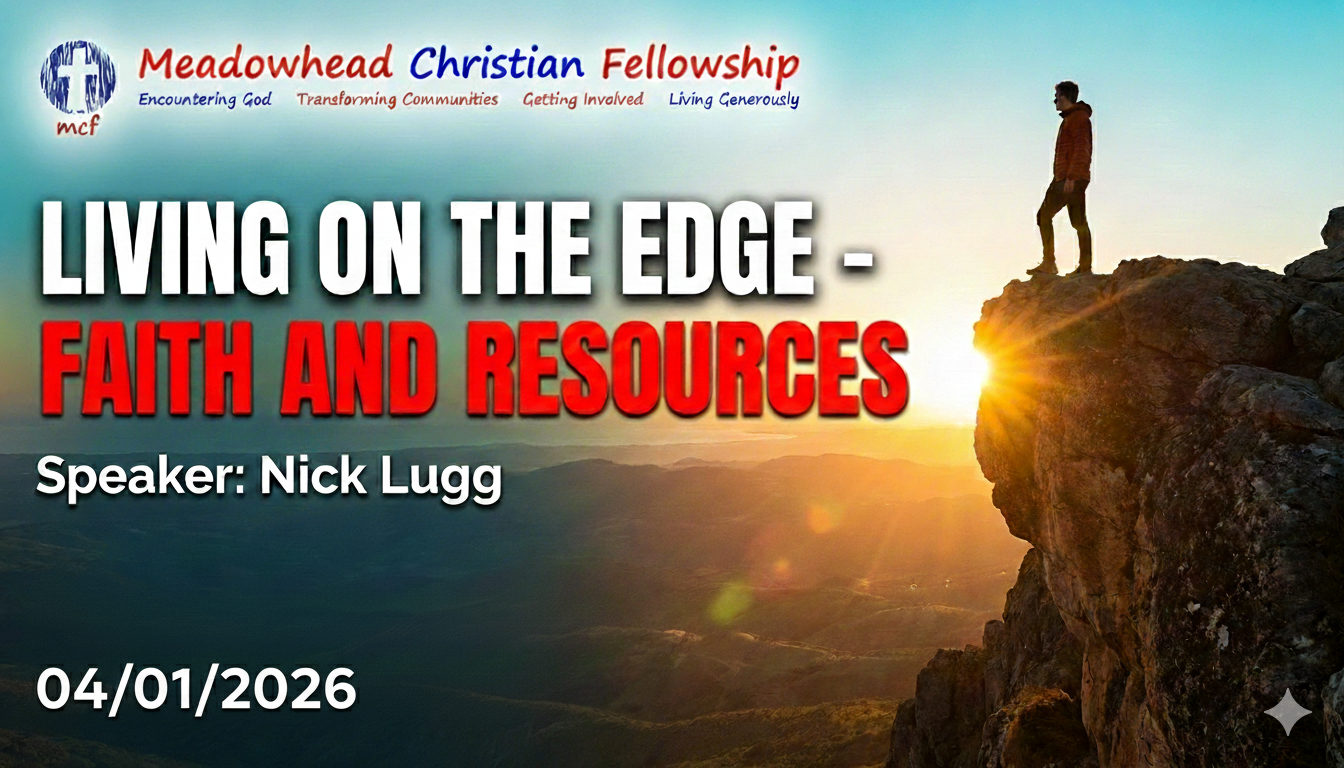
Sunday Gathering – Living on the edge – Faith and resources – Nick Lugg
This sermon, titled “Living on the Edge – Faith and Resources,” was delivered by Nick Lugg at Meadowhead Christian Fellowship in Sheffield. It serves as a spiritual launchpad for 2026, challenging the congregation to move beyond mere belief into active, dependent trust in God.
Sermon Summary
As the church stands at the threshold of a new year, Nick Lugg explores the concept of “living on the edge”—the space where human certainty ends and divine provision begins. He argues that while standing at the edge of the unknown can be unsettling, it is the only environment in which true faith can grow.
Using the context of the church’s upcoming building projects (146 development) and the personal financial struggles he experienced as a missionary in Zambia, Nick emphasizes that God often intentionally pushes His people to the edge of their resources to teach them dependence. He defines a maturing faith through three distinct qualities:
-
Generosity: Choosing to live open-handedly even when resources seem scarce, confronting the fear of “not having enough” with the reality of God’s goodness.
-
Resilience: Refusing to interpret difficulty as God’s absence, instead asking how a challenge is an invitation to trust Him more deeply.
-
Courage: Moving forward in obedience despite feeling afraid, focusing on the next faithful step rather than the entire path.
The message concludes with a call to stop relying on bank balances or personal talents and to put one’s hand into the hand of God, stepping into 2026 with an “honest” faith that makes space for the miraculous.
Quoted Bible Passages (NIV)
Proverbs 3:5-6
“Trust in the Lord with all your heart and lean not on your own understanding; in all your ways submit to him, and he will make your paths straight.”
Psalm 23:4
“Even though I walk through the darkest valley, I will fear no evil, for you are with me; your rod and your staff, they comfort me.”
Philippians 4:11-12
“I am not saying this because I am in need, for I have learned to be content whatever the circumstances. I know what it is to be in need, and I know what it is to have plenty. I have learned the secret of being content in any and every situation, whether well fed or hungry, whether living in plenty or in want.”
Full Transcript
Nick Lugg:
Amen. Bit of a mixed-up day today. It’s great that we’ve been able to share communion together. Obviously, there are things that we pray for. Great to hear encouragement from Mel there as well about how God has been sustaining her.
But it’s also—I want to speak this morning on the title… it sounds very grand: “Living on the Edge – Faith and Resources.” I think when I say “living on the edge,” many people will know what that means. We can feel like we’re sometimes toppling over the edge. But I just want to spend a few minutes bringing some thoughts about what it means to live on the edge and what it means to grow in faith as we step into a new year.
So let’s pray again, shall we? Father, we thank you for your word. Pray that you’ll bring it alive in our hearts, bring it alive in me, that I might be able to communicate what I know is on your heart for us as a church, for me, for all of us as a community. Lord Jesus, I pray that this would be a year of growth, a year of learning the reality of what it means to trust in you. And so we place it all into your hands. We just ask that you’ll speak to us this morning, in Jesus’ name. Amen.
[Offering segment omitted for the summary; see audio for details.]
So, as I said, I want to speak on living on the edge, faith and resources. This is a standalone, like a one-off thing that I want to speak about. I’ve planned this for a little while. And then next week, we’re going to start a series on John’s Gospel. It’s actually two years since we started Genesis. And only about six months since we finished it. So that was a great exercise and a journey through Genesis. And many times, you know, we found that although there was biblical history and there were things that we learned by looking back thousands of years, we also see the reality of Jesus coming through those pages. We learned a lot about our faith and our response to Jesus today through looking at the first book in the Bible.
But one of the things we want to do for the next few weeks and months is focus on John’s Gospel, which has a very clear focus on Jesus himself—the actual account of Jesus’ life and ministry and his death and resurrection. So we’re going to spend some time in John’s Gospel and make resources available if groups want to use them as well, so that we don’t just have the 20-25 minutes we have on a Sunday, but we can have, as a church community, wherever we gather, an opportunity to look into what God is saying to us through those things. So that will start next week.
But today, as I said, I want to speak on living on the edge, faith and resources. So we’re on the edge. We’re on the edge of a new year. It’s always an interesting place to stand. You know, I’m old enough to remember the millennium and the millennium bug and all the chaos that it didn’t cause, but the… and all the fireworks that went off for the first time. I think more or less the first time we had all those fireworks. Now it’s every year. We’ve got these massive millions and millions of pounds going off, everybody celebrating, and there’s almost a question of, well, we’re not quite sure what we’re celebrating. It’s just like lots of bangs and flashes and “oh, it’s a new year, how exciting it is.”
But for people of faith, it really is… it’s nothing different from New Year’s Eve to New Year’s Day in actual reality, but it is important for us to stand and to reflect sometimes. And so for some, it is exciting, a feeling of fresh starts, new possibilities. For others, it can be unsettling—unanswered questions, unresolved pressure, uncertainty about what lies ahead. And often it’s both at the same time, isn’t it? So it can be standing on the edge of the unknown, which isn’t always a very comfortable place to stand.
Christmas 1939, as Britain faced the Second World War, King George VI quoted a poem in his Christmas speech, and it captured that moment. And these words—you may know them, but if you haven’t heard them, I’m going to read them now. It said:
“And I said to the man who stood at the gate of the year: ‘Give me a light that I may tread safely into the unknown.’ And he replied: ‘Go out into the darkness and put your hand into the hand of God. That shall be to you better than light and safer than a known way.'” “Go out into the darkness and put your hand into the hand of Go1d. That shall be to you better2 than light and safer than a known way.” So our circumstances are different than 1939. Some would have you think they’re not that different, but they certainly are different. But the principle is the same. And one thing as I prepared this, I wanted to emphasize is that I believe that 2026 is not just a year for us to continue our belief in God. You know, we believe in God, we’re a church, we come together Sunday by Sunday, we worship, we hear His word, and we go and we live our lives. It’s not just about believing in God, but it is a year to put our faith in Him. To really lean on Him, to trust Him, to depend on Him, not knowing all the answers in advance.
And it’s a really powerful question to ask ourselves: are we ready for that? Are we ready not just to say “I believe in Jesus,” but actually “I will trust Him. I will trust Him with everything that makes my life what it is and makes our life what it is as a church.” Will we trust Him and allow Him to take us beyond that which we know and beyond that which we can see? Because faith grows where certainty ends.
And as a church, we know that God is calling us to big things. We know that we’ve got the development of 146—God willing, all of that will begin to develop much faster now we come into the new year and builders come back from their holidays and all of that. We’re praying and believing for greater impact in our community. We want to see the Gospel changing lives. Not just touching people to say “oh, that’s a nice church,” but actually “this Jesus has changed my life from the inside out.” And that is a sustaining transformation. That isn’t just a flash in the pan of people saying “oh, this was great, I had a good experience in the church,” but actually it’s a lifelong transformation. That’s what we want to see in our lives and in the lives of our community.
And we want growing clarity about God’s vision for our future. Why is it that God has placed us here? We can say we have a mission to our community, we have a mission to Jordanthorpe, Batemoor, we have a mission to Sheffield, but what does that really mean? What does that really look like? What is God calling us to be? And how is He calling us to shape ourselves? And as we grapple with those questions, we know that none of them come with guarantees.
And for many individuals and families, 2026 already feels uncertain. You’re looking and you’re not sure. There’s change on the horizon. Things are moving, things are shifting. Faith doesn’t mean certainty about events. It can be certain of things we hope for, certain of things we do not see, but not certainty about events or certainty about the way things will work out.
And in Proverbs it says, “Trust in the Lord with all your heart and lean not on your own understanding,” because faith begins where our understanding runs out. We love to understand everything, don’t we? Love to have a handle on everything and say “I know,” that’s why we… fear and insecurity makes us controlling. We try and control everything, and faith teaches us that we can’t, but we can trust in Jesus.
Psalm 23 doesn’t promise that we avoid the valley, but it says “Even though I walk through the valley of the shadow of death, I will fear no evil, for you are with me.” So the comfort of God’s presence is discovered in the valley, not instead of it. He doesn’t allow us to bypass the valley. He says “Even though I walk through the valley, I’ll still find you there. I’ll still know your presence there.” And that’s really uncomfortable because we would love a faith that said, actually, I can call down all the favors of heaven and I will avoid all the valleys of life and all the challenges and all the difficulties. And we know—you know—that’s not real, is it? That’s not fact. We know that sometimes we have to face the valleys head-on. But even though we walk through those valleys, we will fear no evil, for you are with me.
Fear and anxiety are the oldest burdens of the human race. From the moment Adam and Eve sinned, we’ve known what fear is. When they sinned and they ran away from the presence of God and God found them, and Adam said, “Actually, we hid from you because we were afraid.” Where did that come from? That came because of the deficit that had come in the human heart because of sin. But where fear and anxiety are present, then we know that faith can grow. It’s an opportunity for faith to grow. It’s a fertile ground for faith to grow.
And so we can be stepping into 2026—we can jump and cheer and whoop at the fireworks, but there’s a nagging feeling in the back of our minds that perhaps we have more questions than answers. Maybe about finances, maybe about your health, relationships, direction that your life is taking or should take. And if you have those questions, that’s not a bad place to be. That doesn’t mean that we’re failing; it means that we’re standing in the right place for faith to grow.
God pushes us to the edge and allows faith to grow in that place. Why does God provide at the edge? Why doesn’t He just give us everything that we want? He’s got all the power, He’s got all the resources, He owns the cattle on a thousand hills. He could just give it to us. You know, why is the funding of God’s vision for 146… why is it a struggle? He could just give it to us. But He doesn’t; He pushes us to the edge. Why do we need to go through struggle in life? He pushes us to the edge in order that faith can grow.
So He made Israel dependent on daily manna from heaven. Elijah was fed by ravens. The disciples were asked to feed thousands with nothing. God has all those resources—God has more than five loaves and two fish. But there was something that He wanted to teach, something that He wanted to drill into their hearts. And He tells us those stories not so that we can replicate them, not so that we can all walk on water… I read—it’s not a funny story, it’s a tragic story—but it is a weird story of a pastor somewhere who thought, “You know, I’ve got so much faith, I can walk on water,” and he stepped out on the water and sank and never came up. You know, it’s not about walking on water, or like, if you’re old enough to remember The Secret Diary of Adrian Plass, making paperclips move by faith or any of that sort of stuff.
But it’s so that we learn never to plan without God. Never to enter a period of time without budgeting for God, without making room for the actions of the Holy Spirit. We’re not entering a new year without thinking: what can God do? Our New Year’s resolutions are a faithless effort to shore everything up. “I know what this year holds because I’ve made a resolution.” Well, we all know that they all fall apart on the second of January. So there’s no point in trying to control the year ahead, but there is a point in making space for God to move. God’s provision stories are about creating space for Him to act, not about us being heroes.
So what are you anxious about right now as you go into 2026? What are you hoping to achieve? What’s on your mind? What’s on your heart? And maybe it’s only you that knows it. But the question is: have you made space for God in all of that? Have you made space for God in your planning? Or have you already decided what’s possible or what’s impossible? So easy to decide what’s impossible, isn’t it? “Oh, it couldn’t happen.”
But in actual fact, what I believe God is calling us to do is to make space in our planning, make space in our thinking, give margin for God to move. Whether it’s as individuals or families, or whether it’s as a church, we have to… we can’t plan our year as a church just by looking at what happened last year. So easy to do that. Look back, “oh yeah, we did all this in the planning, we’ll just photocopy the planner from last year and just shift it on a date and everything…” and we’ll get back to next year and we’ll all be happy. Well, we won’t all be happy. There’s so much that God wants to do as we put our faith and our trust in Him.
Now, I realized actually this year that I’ve been a Christian for 40 years. That sounds ridiculous, doesn’t it? I know I don’t look that old, but… I could give countless testimonies of what God has done over those years and how He’s shown Himself strong in my life. It’s just amazing when you think back—miracle upon miracle. I’m sure the same for any of us here; we could give stories about what God has done. And sometimes those things have happened when faith has felt the weakest.
There are many, many things that I could tell you that are probably… I’ve got one story that just came to mind, but I could tell you so many that are more significant, that are maybe even life-and-death situations. But there’s one that reminded me when I was thinking about what it means to be pushed to the edge. And we lived in Zambia for a number of years, as many of you will know, and we lived among people that struggled an awful lot and were an inspiration to our faith in so many ways.
But we encountered—for us it was serious, but in terms of everything else it was probably quite mild—but we had one particular time when a perfect storm hit us and we ran out of cash completely. The ATMs weren’t working. There wasn’t any fuel so we couldn’t get out of town. The internet was down so we couldn’t send out a prayer letter. We couldn’t contact anyone. We couldn’t do anything. We had no food. We couldn’t feed the children. They were supposed to be going to school and they needed stuff for school. And for the first time, we experienced what it meant to have absolutely no power to fix the situation.
And so you know what we did? We thought, “Oh well, we better pray.” Because that’s where God pushes us to the edge. If we’re not at the edge, if we’ve got all of that surplus and all of that abundance and all of that… why do we need God? But we ended up in a situation where we could have said, “Well, where’s God? He’s supposed to provide for us.” But in actual fact, we found that we had nothing and so we were pushed towards Him and we prayed. Not long, impressive prayers, just honest ones that culminated in us making a list of what we needed.
And as we basically—as we wrote that list or as we finished it off—there was a knock at the gate. And two ladies—two old ladies that we loved, women who have very little themselves, suffered so much in their lives—stood at our gate with two carrier bags, inside with almost exactly the things that we’d written down on our list. And they said, “Well…” and we were praying—this was like because it takes them quite a long time to get from where they live to the shops to our house. So they’d done all this before we started praying. But they said, “God, we were praying this morning, God told us to buy these things for you.”
The supplies didn’t last long—you know, bread and jam and whatever—but the lesson has lasted a lifetime. And faith grows when we experience God in the impossible situations. And if you’re facing an impossible situation, whether it’s a small thing like that or whether it’s a really big thing, you’re in the place where faith can grow. Faith can grow this year in 2026 as we face impossible and challenging, difficult situations.
So our faith is about formation, not the outcomes that it brings. Paul the Apostle Paul wrote in Philippians 4: “I have learned to be content whatever the circumstance, whether well-fed or hungry, whether living in plenty or in want.” He thanked the Philippians for their generosity—they’d sent him a gift—and he said, “I don’t need that gift, but what it shows me is what is happening in your heart. What it shows me is your faith—that out of your poverty, you have chosen to give to me. And that to me gives me pleasure. I know,” he said, “that God will provide for me whatever happens, whether it’s through you or through anybody else. But nevertheless, my joy comes from seeing that you’ve done it, that your faith has grown, that you have met these needs.”
And so faith—growing in faith is not about guaranteeing outcomes. It’s not about… it’s not like the prosperity gospel where we’re thinking about all the time “what are we going to get by our faith?” But it’s about knowing God more deeply. Because God is faithful even when we are faithless. I have found that to be absolutely true. That God has never—when we sing those songs “You have never let me down, you’ve never failed once, you won’t fail now”—those things are absolutely true. But not because of my prayer life, or not because of my righteousness, or not because I’ve got all the… all the ducks in a row and everything all in order and so therefore God is ready to answer my prayers. He’s simply faithful, even when we are faithless.
But He invites us into the process because faith changes us. So He’s faithful to provide. He is Jehovah Jireh. He will provide all our needs because of who He is by nature of His character. But nevertheless, He invites us into the process, invites us to exercise our faith, invites us to do our bit. And so when faith moves from belief to trust, it doesn’t just change what we think, it changes how we live.
So the reality is that uncertainty, pressure, and limited resources are here to stay, because that does us good. God owns all the resources of heaven and earth, and yet if He gave it all to us, we would just fall in a heap in terms of our faith. So uncertainty, pressure, limited resources, unanswered questions—those things are good because they push us into a situation where our faith grows and where our faith can take on three visible qualities: our faith can be generous, resilient, and courageous.
So faith is generous. Do you know that faith—I’ve said it over and over again this morning—faith doesn’t begin with abundance? It begins with trust. To be generous in our hearts is not about how much we have; it’s about what we believe God is like. If we believe that God is reluctant, if we believe that He’s limited or unreliable, we hold tight to everything that we’ve got. Because we don’t… we believe if we let go of it, He can’t replace it. He can’t give to us, He can’t pour out His abundance. We can’t trust Him—that I need the resources that I have, I need the money, I need the time, I need the energy, I need all of those things held tightly to me because if I give them away, I’ll be finished because God is not reliable.
But if we believe God is good, faithful, and a provider, we can live open-handed. We can live generous, we can live free, we can live with joy. And that’s why generosity in all areas of life is such a powerful act of faith. Because it confronts our fear directly. Not just financial fear, but to be honest, that is the one that comes very often in our lives. Those are the things that trouble our minds the most—fear of not having enough, fear of not being enough, fear of not being secure enough, fear of what might happen. Because we’re not that sure that God is who He says He is or He’ll do what He says He’ll do when He says that He’s a faithful provider, when He says that He’s a strong protector, when He says that He’s our security and our strength. We’re not too sure that if we put Him to the test, if we’d find out that that was true.
But if we attend to what we believe about God and we put our faith and our trust in Him and we actually decide that regardless of what our life looks like, regardless of what the circumstances are appearing to suggest to us, dare we believe that God is good? Dare we believe that God is faithful? Dare we believe that God will see us through? Dare we believe that God will part the sea and do the miracles? Then we won’t be disappointed.
But we struggle… you know, we don’t struggle to believe that He provides, but we struggle to act as if He does. We struggle to shape our lives according to that. And so we’ll speak a good game when it comes to our faith, but will we act it? Will we do it? Will we put it into action? Will people looking from the outside see “this is the God they believe in”? Because they might actually listen to the words that we say, but will they see it in the way that we live? Will they see faith in the way that we respond to challenge? Will they see faith in the way that we are generous? Will they see faith in the way that we interact with one another?
And so there’s a challenge for the new year—not a resolution, but a challenge. Where am I living closed-handed because of fear? And what does generosity look like for me? It might be finances, it might be time, it might be hospitality, it might be forgiveness, it might be encouragement, it might be attention. It might be any one of those things. But let’s choose an intentional act of generosity that actually stretches our trust in God. Not driven by guilt, not driven by “I ought to” or obligation, but faith-filled generosity that demonstrates to God and to those around us that “God, I trust you more than I trust what I can see.”
There was a lady in our first church who really struggled with this. She was a single mum, she’d been deserted by her husband, she’d got no money—or very little money to live on—and she had no idea. And she was challenged in the idea of giving. And her first response was, “I cannot afford to give anything. This is just my lot in life.” And without anybody twisting her arm or getting into her mind or saying “you really need…” she started to get challenged and convicted by the Holy Spirit.
And so she did this: she tried to work out an intentional act of generosity. She struggled to actually give, but she said, “What I can do is the amount that I want to give, I can put it in an envelope and I can put it on my mantelpiece in my house. And then when I run out of money, I’ll be able to use that money. But I just want to see what is possible.” And so she started doing all of that. And guess what? The month passed and the money stayed there, because God had proved Himself to be faithful to her in every way. And so it took that intentional act.
She could have stayed in her mind and said, “Well, I know what is impossible. I know what cannot be done because of my circumstances and because of my difficulty.” But she chose to step away from those things to look to God and say, “Actually, I will trust you more than what I can see.” And God proved Himself over and above. And let 2026 be a year when we prove to ourselves and we see God move in miraculous power. Have you ever recently put yourself in a position where you need God to move in your life? Let’s be intentional about putting our faith into action this year.
Faith is resilient. Resilience is not pretending things are fine when they’re not. We’re good at that, aren’t we? You know, “yeah, God is great,” whatever, but inside we’re collapsing. Faith doesn’t eliminate hardship but gives us a place to stand within it. Like I said, Paul said he learned contentment in every circumstance. Not because circumstances were easy, but because God is faithful.
So resilience grows when we stop interpreting every difficulty as God’s absence. Instead of asking all the time “God, why is this happening?”, why don’t we ask “How are you inviting me to trust you here?” Resilient faith doesn’t deny pain, but it refuses to allow pain to define God.
And so think about this year, going into this year: where have we been tempted to give up, disengage, or withdraw? Let’s decide in advance—even before difficult circumstances have come—that those difficulties will not silence our worship or prayer or our obedience. Resolve, if we’re going to make a resolution, let’s resolve that we keep showing up, we keep praying, we keep trusting even when answers are slow. So that we can say at the end of 2026 that through it all, Lord, you have been faithful.
Thirdly, faith is courageous. Courage is not confidence; it’s obedience in the presence of fear. Most significant steps in the Bible, most significant steps in life, happen with trembling knees. It doesn’t happen when we feel ready, when we feel able, when we feel strong enough. But it happens when we decide to trust regardless of how we feel.
And if we make an honest assessment of the challenges ahead—whether it’s for us personally, as families, or as a church—they can easily overwhelm us. So easily. If you… we keep reminding ourselves and laughing about when we bought 146—use that as an example—and somebody said, “Oh, you won’t get much change out of £250,000 for renovating.” And then somebody said “It’s going to cost a million pounds,” and we said “No, no it won’t.” And then of course you add it up and it’s going to cost more than a million pounds. And those sort of things are the things that can overwhelm your faith. They can overwhelm you and you think, “Actually, wow, this is more than we thought. This is bigger than we imagined it was going to be.”
But courage doesn’t begin with analysis; it begins with God. It begins with what He can do. When God says “go,” our courage says “I don’t know how it’s going to work, but I trust who you are, God.” And we can honestly say that through that project, God has been faithful right up until today. God has been faithful and as we look forward into 2026, we see a year where we see that project coming to completion by God’s grace.
Is there anything you’ve delayed in your life because you don’t feel ready? Where is God prompting you to step up, speak out, step out? Is there a step of obedience that you’ve been avoiding? Take it this year. Not ten steps, not a leap into the unknown, just the next faithful step that you know God is asking you to do. What is God challenging you about? Where have you decided to settle back and think “Actually, I’ll stay with what I know, I’ll stay with what is safe”? Because in actual fact, staying with what is safe is not safe at all, because things change all the time. Things crumble around us, things move, things shift. Faith requires us to trust in God—not to see the whole path, but to trust Him with the next step.
It’s not about being heroes of faith. Sometimes the stories of the heroes of faith discourage us rather than encourage, don’t they? Think, “Well, I couldn’t do that.” But it’s about being honest Christians choosing to trust God when our certainty runs out.
And so standing at the edge of 2026, the question isn’t “Do we have enough faith?” or “Do we have enough resources?” but the question is simply “Who do we trust? What do we trust?” Do we trust our bank balance? Do we trust our family? Do we trust those closest to us? Do we trust our understanding of the future? Do we trust our own abilities or our talents or our resources or whatever it is? Or do we trust God? Do we put our hand into the hand of God and walk into the unknown with Him?
And so as we live on the edge of 2026, our takeaways are that:
-
Faith is generous—trust God enough to give even when it feels risky.
-
Faith is resilient—stand firm when life challenges you.
-
Faith is courageous—step forward in obedience even when you feel afraid.
And so let’s pray and maybe the team can come back and as we worship, let’s turn our hearts to God and think about what that means. I believe that God has application for us in all sorts of different ways—different responses that we might have. You might be carrying different challenges. And if as we worship, you know that there are steps that you need to make to establish your trust in God—you know you need to trust Him but you don’t know how, you don’t feel it—then take this opportunity to step into 2026 and step forward and come and pray. Because there is an opportunity for us to pray together. Don’t even need to know the details, don’t even need to know what’s going through your mind or through your head or through your heart, but we can stand together and pray. Make a statement to God that, “Yes, I’m going to trust you, whatever happens in 2026, or with whatever is burdening me now, I’m going to give it to you, Lord, and I’m going to trust you and I’m going to believe you and I’m going to make space for you to do the miraculous.” And so let’s worship, and if you need to make a response, please do, and please do step forward so that we can pray together.